The Cabinet · Bristol · 1852–1883
The Clock With Two Minute Hands
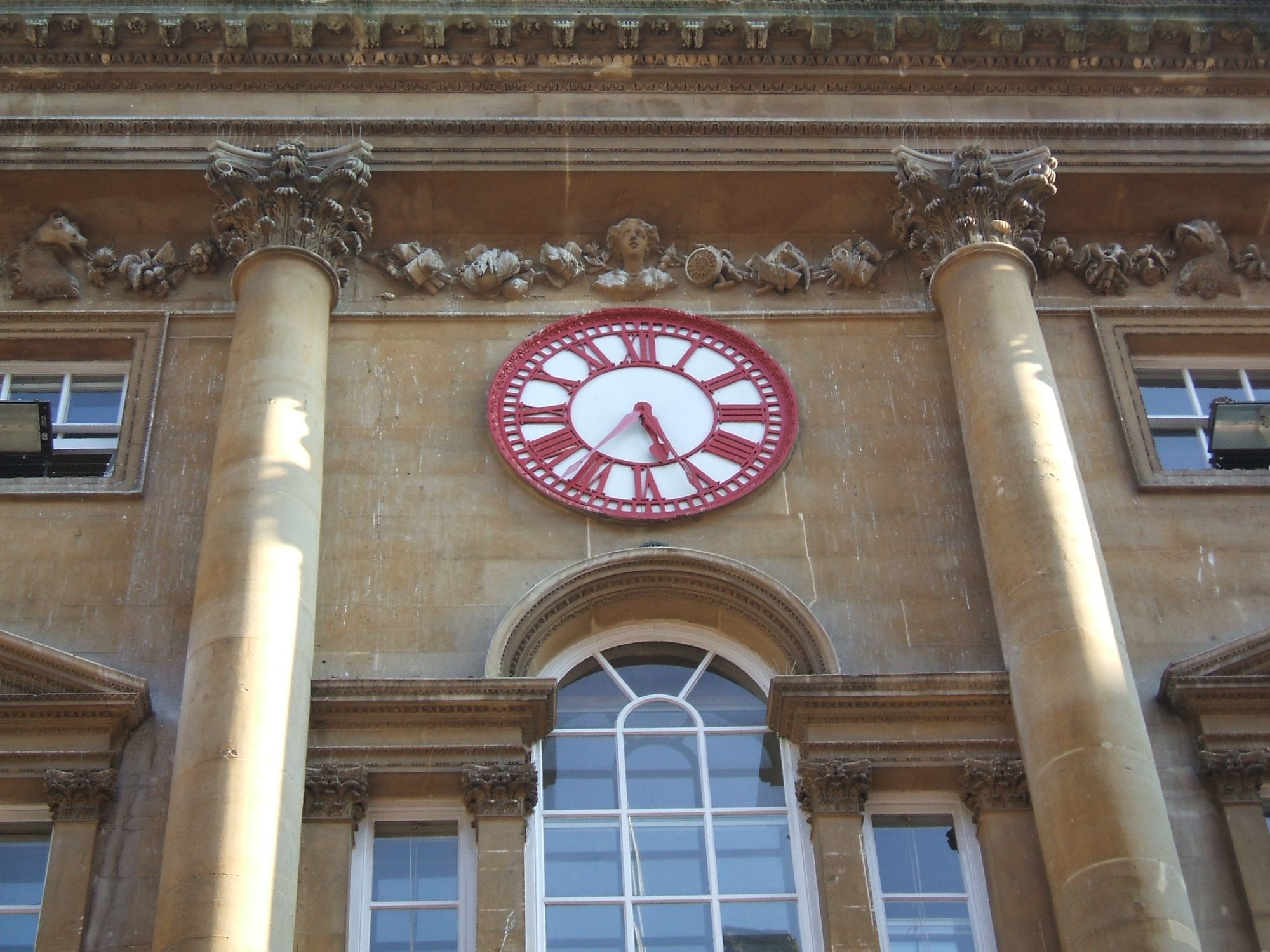
On the front of the Corn Exchange in Bristol there's a clock with an extra minute hand, set about ten minutes apart from the other. It's a fossil from the time before time was standardised, when every town ran on its own clock and that was completely sensible.
Epistemic status The dates and the mechanics are well established. The argument that local time was rational, not quaint, is my framing, though I think it's hard to argue with once you see it.
I.
Here’s a question that sounds stupid and isn’t: what time is it?
The obvious answer is to look at your phone. Your phone asks a network, the network asks a satellite or an atomic clock, and the answer comes back the same for everyone in a zone that spans hundreds of miles. That system is about a hundred and fifty years old. For almost all of human history, the answer to “what time is it?” was “look at the sun.” And because the sun is in a different place depending on where you’re standing, the answer was different in every town.
Bristol is a little over a hundred miles west of London. The sun reaches its highest point over Bristol about ten minutes after it does over London. So for most of history, noon in Bristol was ten minutes later than noon in London, and nobody minded, because nobody could get from one to the other in less than a day.
Then the railway came, and suddenly everyone minded very much.
II. Exhibit A: the clock
The Exchange on Corn Street, a grand Georgian building where Bristol merchants did their deals, got a public clock in 1822. At some point after that, it was given a second minute hand.The clock itself dates from 1822. According to Bristol City Council, the second minute hand was added later, as the gap between “London time” and “Bristol time” became a practical problem. Today the red hand shows Greenwich Mean Time, and the black hand shows Bristol’s local time, about ten minutes behind.
It’s a wonderful object, because it’s a physical record of a society changing its mind about something you’d think could never be up for debate. It says: there are two reasonable answers to the question “what time is it?”, and we are going to show you both.
III. Why local time made sense
It’s tempting to think of local time as a quaint, inefficient thing that people put up with until they knew better. I want to argue the opposite: local time was the rational system, perfectly fitted to the world it served.
If you’re a farmer, a shopkeeper, or a merchant in 1800, what you care about is daylight. When does it get light, when is the middle of the day, and when do you need to light the candles? Local solar time answers exactly those questions. Noon means the sun is highest, right here, now. A time standard set somewhere else, a hundred miles away, would be slightly wrong for everything you actually do.
And the costs of local time were tiny, because nothing moved fast enough to notice. A stagecoach from London to Bristol took most of a day. Arriving ten minutes “early” by your pocket watch was irrelevant against delays measured in hours. The coaching inns could just adjust.Mail-coach guards are said to have carried timepieces deliberately adjusted to gain or lose over the journey, so they’d roughly match each town’s clock on arrival. Even the eighteenth century had its jet lag, just slower.
Goethe, crossing into Italy in 1786, found that the Italians kept an even more local system. Their day began at nightfall, so the hours were counted from sunset. It meant noon fell at a different “hour” depending on the season. Sitting in Verona, he drew a diagram of three concentric circles to work out the conversion. His conclusion, roughly: right now, “noon is seventeen o’clock.” He thought the locals rather enjoyed the constant arithmetic, and that they’d be lost without it:
If the people were forced to use a German clock they would be perplexed, for their own is intimately connected with their nature. Goethe, Italian Journey, Verona, 1786, trans. Morrison
That’s exactly the point. Every place’s time was tied to its own sun, its own church bells, its own working day. Time wasn’t a fact about the universe. It was a fact about here.
IV. Then the trains
The railway broke all of this. A train that left London at noon by London time and arrived in Bristol a few hours later had to publish a timetable. Which noon did that timetable mean? Every station was on a slightly different clock. For passengers trying to catch connections, it was chaos.
So in November 1840 the Great Western Railway, the line Isambard Kingdom Brunel was building from London to Bristol, did something radical: it ran all its trains on London time, regardless of where the station was. Other lines followed. Station clocks were set to “railway time,” and town clocks stayed on local time. And so a town like Bristol found itself running on two times at once: the time the railway said and the time the sun said.
That’s what the second minute hand is about. It’s a clock trying to keep everyone happy.
Bristol held out for a while, and then on 14 September 1852 it officially switched to Greenwich time. By the mid-1850s, by one contemporary estimate, around 98 per cent of public clocks in Britain showed Greenwich time. The law didn’t catch up until 1880, when an Act of Parliament made Greenwich Mean Time the legal time across Great Britain.
V. The rest of the world, grudgingly
Britain was small and had a single dominant railway network. Big countries had it much worse. In the United States in the early 1880s, the railways were running on dozens of different local times. On 18 November 1883, the railways adopted a handful of standard time zones on their own authority. That day became known as “the day of two noons,” because at many stations the clocks struck twelve, then were reset and struck twelve again a little later. The US government didn’t make the zones law until 1918.
A Scottish-born Canadian engineer named Sandford Fleming became one of the great campaigners for a worldwide system of time zones after, the story goes, he missed a train in Ireland in 1876 because the timetable printed “p.m.” where it meant “a.m.” In 1884, at the International Meridian Conference in Washington, the nations of the world chose Greenwich as the prime meridian, the zero line for longitude and time.
Not everyone was gracious about it. France kept Paris time for decades afterwards. When it finally aligned with Greenwich in 1911, the law didn’t mention Greenwich at all. It defined French legal time as “Paris mean time, retarded by nine minutes and twenty-one seconds”, which is, of course, exactly Greenwich time. It’s one of the great passive-aggressive pieces of legislation in history.
VI. What we gave up
I don’t want to romanticise local time too much. Standard time is a genuine triumph, a coordination problem solved at planetary scale, and the modern world could not function without it.
But there’s a small loss buried in it, and the Bristol clock is a good place to feel it. Time used to be local. It belonged to a place, the way a dialect or a recipe does. When it’s noon on your phone, the sun is almost never exactly at its highest point over your head. Depending on where you are in your zone, and on the season, solar noon might be half an hour off or more. We traded our noon for everyone’s noon, and we were right to. But we did trade something.
So if you’re ever on Corn Street in Bristol, look up at the clock with two minute hands. One shows the time the world agreed on. The other shows the time the sun is keeping, right where you’re standing. They’ve been about ten minutes apart for a hundred and seventy years, and neither one is wrong.
Go see it
- On the street
The Corn Exchange clock
The Exchange, Corn Street, Bristol, by the entrance to St Nicholas Market
The red minute hand shows Greenwich time, and the black one shows Bristol's own time, about ten minutes behind. Stand opposite and watch them move together, never quite agreeing.
- On the street
The gate of the Royal Observatory, Greenwich, London
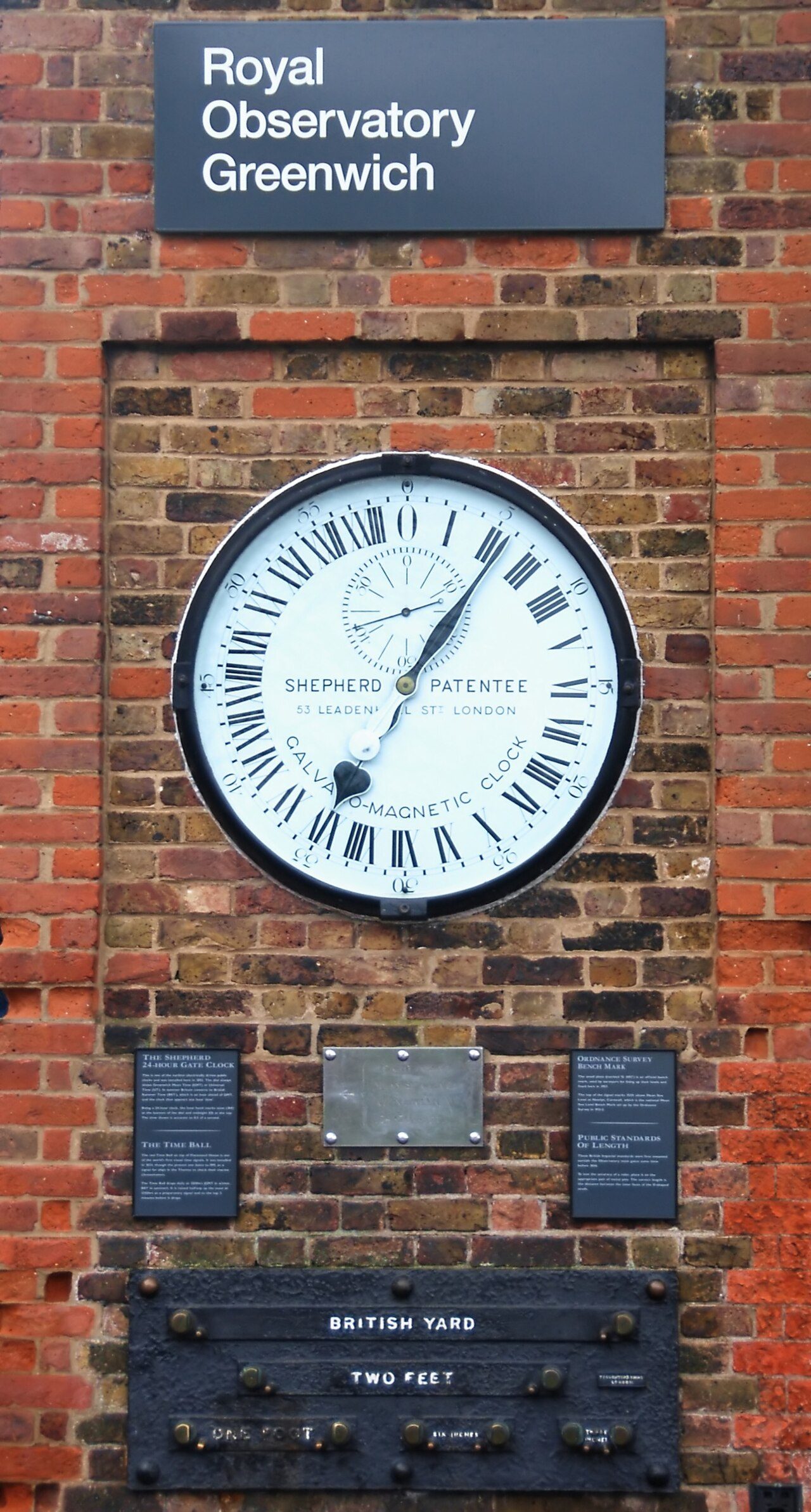
Put up in 1852, it was the first clock to show Greenwich Mean Time to the public. It has a 24-hour dial, so noon is at the bottom.
Read further
Images: Chris Mitchell · CC BY-SA 4.0 / Alvesgaspar · CC BY-SA 3.0

