The Post · Misenum, Bay of Naples · 79
The Letter That Named a Kind of Volcano
A historian asked a seventeen-year-old's grown-up self how his uncle died. The answer, two letters about the eruption of Vesuvius in AD 79, is the first eyewitness account of a volcanic eruption we have. And it might have the date wrong.
Epistemic status The letters are real and well preserved. The date of the eruption is a live scholarly argument, and I've tried to give both sides a fair shake before saying which way I lean.
I.
The most famous letter in volcanology started as a favour.
Sometime around the year 106, the historian Tacitus was writing his Histories, and he got in touch with an old acquaintance, the lawyer and senator Gaius Plinius Caecilius Secundus, whom we call Pliny the Younger. Tacitus had heard that Pliny’s uncle, the admiral and naturalist Pliny the Elder, had died in the eruption of Vesuvius more than twenty-five years earlier. Pliny had been there. Could he write it down?
Pliny wrote back twice. The first letter opens with exactly the kind of throat-clearing you’d expect from a man who knew his letters would be published:
Your request that I would send you an account of my uncle’s death, in order to transmit a more exact relation of it to posterity, deserves my acknowledgments; for if this accident shall be celebrated by your pen, the glory of it, I am well assured, will be rendered for ever illustrious. Pliny the Younger to Tacitus, Letters VI.16, trans. Melmoth
Then he gets on with it, and it is extraordinary.
II. What he saw
In AD 79 the elder Pliny was commander of the Roman fleet at Misenum, the naval base at the northwestern tip of the Bay of Naples. His nephew, who was seventeen, was staying with him, along with the boy’s mother. One day, early in the afternoon, the mother pointed out a cloud of unusual size and shape rising from a mountain across the bay. Nobody could tell at first which mountain it was. Here’s how Pliny describes it:
…the appearance of which I cannot give you a more exact description of than by likening it to that of a pine tree, for it shot up to a great height in the form of a very tall trunk, which spread itself out at the top into a sort of branches… Letters VI.16, trans. Melmoth
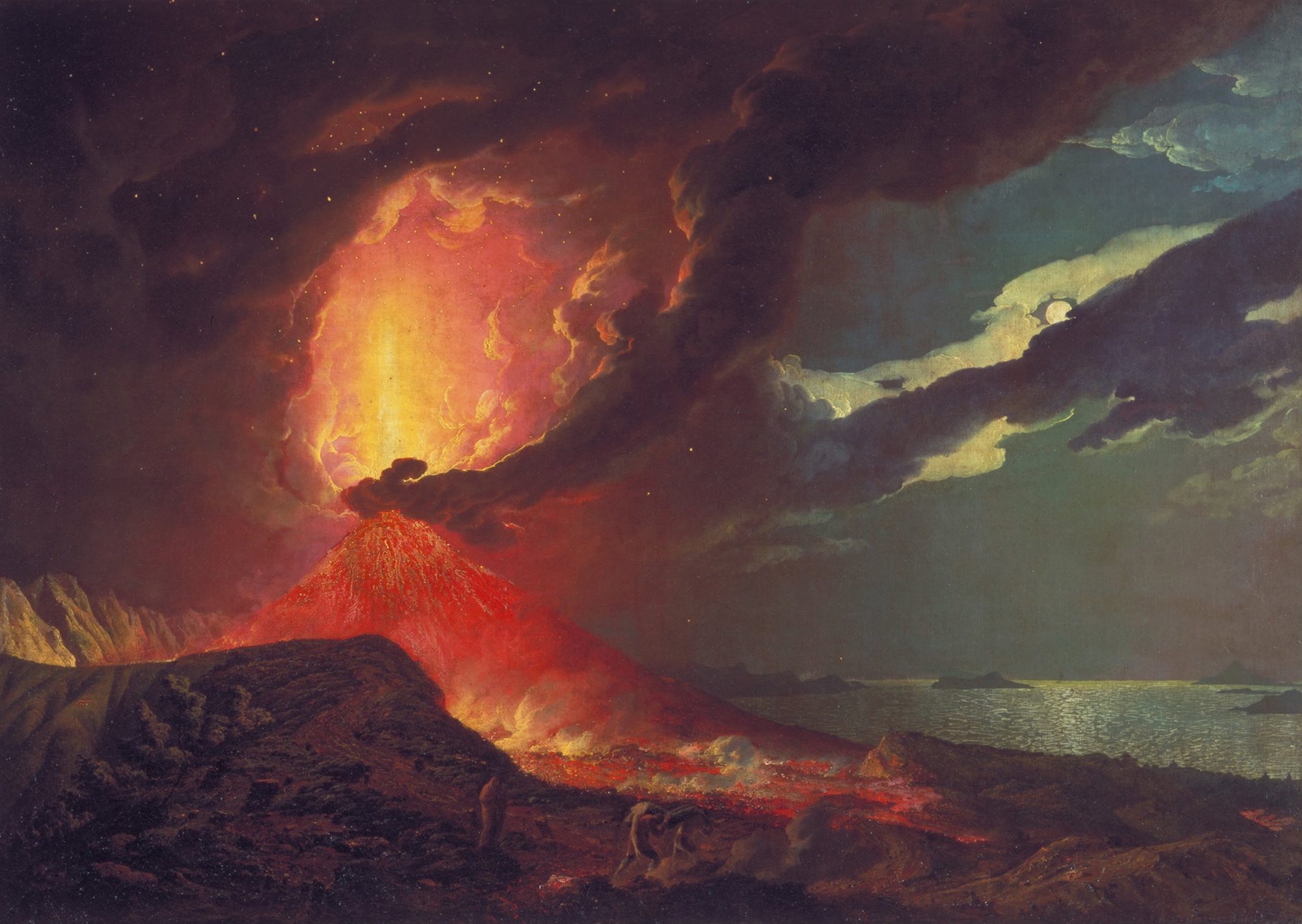
He means the Mediterranean stone pine, the tree with a tall bare trunk and a flat spreading canopy, like an umbrella. You still see them all over Rome. And it’s a perfect description of what volcanologists now call an eruption column: a jet of gas and ash shooting kilometres into the sky and then spreading out sideways when it hits the stratosphere. It’s so perfect that this whole category of eruption is now named after him. A Plinian eruption is the explosive kind, the kind with the pine tree.The convention is that Pliny the Younger, the one who described it, gets the honour. The uncle, who actually went to look, got a crater named after him on the Moon, which seems like a fair trade.
The uncle, being a naturalist, wanted a closer look. He ordered a light ship made ready. Then a message came from a woman trapped on the shore beneath the mountain, and he turned it into a rescue mission, launching the big warships across the bay. He landed at Stabiae, at a friend’s villa. He bathed, dined and, according to his nephew, slept, while ash and pumice piled up in the courtyard. In the end he went down to the shore to see if they could escape by sea, and died there, apparently overcome by fumes.
III. Meanwhile, the nephew did his homework
And the seventeen-year-old? The second letter, written because Tacitus asked a follow-up question, tells us what he did. And this is the part I love, because Pliny tells it on himself with no apparent embarrassment. While the mountain was erupting across the bay, he stayed behind with his mother. And he read.
…I took up Livy, and amused myself with turning over that author, and even making extracts from him, as if I had been perfectly at my leisure. Letters VI.20, trans. Melmoth
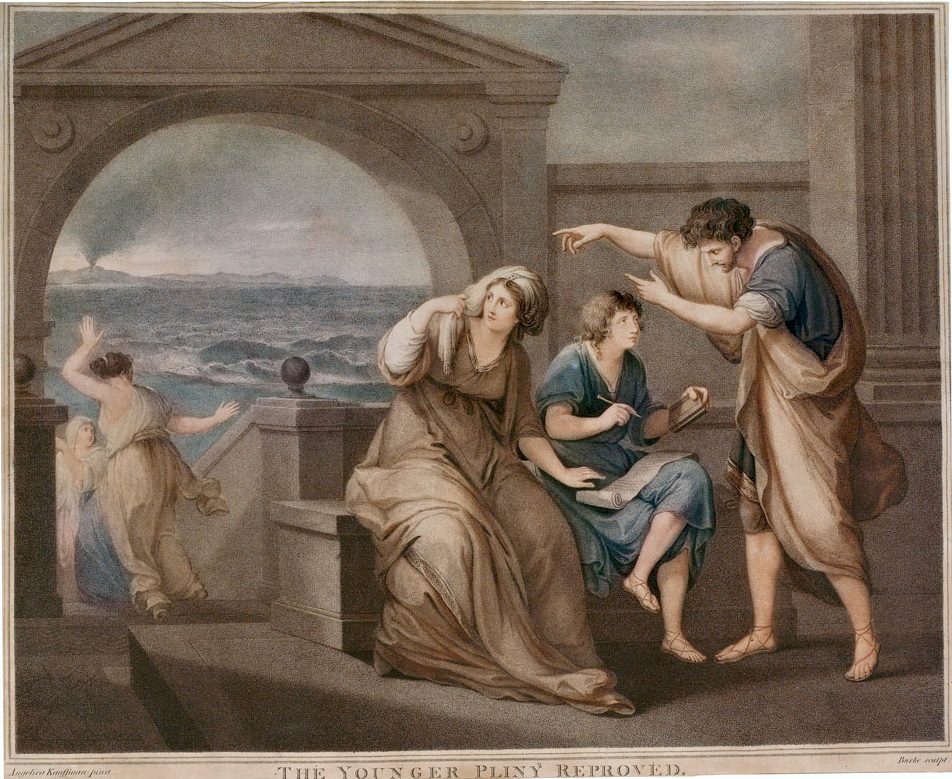
A friend of his uncle’s, just arrived from Spain, found the two of them sitting there and gave them both a talking-to: the mother for putting up with it, the boy for his carelessness. Pliny went on reading anyway. Then the earthquakes got worse, and the sea sucked back from the shore, and a black cloud came down across the bay, and they finally ran for it. They escaped in the dark along with a panicking crowd, and Pliny gives one of the earliest descriptions we have of what it’s like to be inside a disaster: people calling for their children, praying for death, convinced it was the end of the world.
This is why Angelica Kauffman, painting the scene in 1785, chose this exact moment for her picture: a young man with a book in his lap, refusing to be impressed by the apocalypse. It became a popular print. Grand Tourists loved it. They had all read Pliny at school, and a lot of them had just climbed Vesuvius.
IV. The problem of the date
Here’s where it gets interesting in the way I like.
For centuries, everyone “knew” the eruption happened on 24 August, AD 79. The date comes from Pliny’s letter. The manuscripts give it as nonum kal. Septembres, “the ninth day before the Kalends of September,” which works out to 24 August.
But there was always something a little off about August. Archaeologists at Pompeii kept finding things that looked autumnal: fruits like pomegranates that ripen later in the year, people who seem to have been wearing heavier clothes, wine that appears to have been sealed up after the harvest. None of these on their own is conclusive. You can tell a story in which each is a coincidence or a misreading. But they kept adding up.
Then, in 2018, excavators at Pompeii found a charcoal inscription scrawled on the wall of a house that was being renovated at the time of the eruption. It’s dated to the sixteenth day before the Kalends of November, which is 17 October. Charcoal is fragile. Scribbled on a wall that was being redone, it’s very unlikely to have survived long. So if it was written on 17 October in the year 79, the eruption must have come after that. Many scholars now suggest 24 October.
So how do we square that with Pliny?
V. How to weigh a manuscript against a scribble
The traditional view says Pliny was there, he wrote the date down, and you should trust him over a builder’s graffito. That’s a reasonable instinct.
But think about what we actually have. We don’t have Pliny’s letter. Nobody does. We have copies of copies of copies, written out by hand by monks over the following thousand years or more. Every copying is an opportunity for error, and dates written in Roman numerals, with their run of Is and Xs and abbreviations for Kalends, are exactly the sort of thing that gets garbled. In fact, the manuscripts don’t all agree on the date. Different copies give different readings, and the 24 August date became standard partly because editors chose it.
The graffito, on the other hand, has not been copied by anyone. It’s the original. It could have been written in an earlier year, but if so, it’s odd that a scrawl in charcoal on a wall under renovation would survive a whole year.
My own view, held at maybe 70 per cent: October is more likely than August. That’s not because the scribble beats Pliny. It’s because the scribble beats a thousand years of photocopying Pliny, and because it lines up with the pomegranates and the warm clothes. But I could be talked out of it, and the question isn’t settled.
VI. Why this is in the Post
I’ve put this piece in our department about letters for a reason. These are letters, written by one person to another, about a private grief, with an eye on publication. They are also among the most consequential letters ever written. A historian’s polite request produced the founding document of a science, named a type of eruption, and fixed a date in every textbook that might be wrong by two months because of a monk’s slip of the pen.
And in the middle of it all is a seventeen-year-old who decided the end of the world was no excuse to stop doing his reading. He’s my favourite person in Roman history.
Go see it
- Online
Pliny's letters to Tacitus (Melmoth's translation)
Project Gutenberg. The two Vesuvius letters are Book VI, letters 16 and 20.
- On the street
Capo Miseno
The headland at the western tip of the Bay of Naples, near Bacoli. A short bus or taxi ride from Pozzuoli.
Pliny watched the cloud rise from here. On a clear day you can see Vesuvius across the whole bay, about thirty kilometres off.
- On the street
The villas of Stabiae
Castellammare di Stabia. Villa Arianna and Villa San Marco, part of the Pompeii archaeological park and much quieter.
Pliny the Elder came ashore near here and died on the beach.
Read further
Images: see description · Public domain / Joseph Wright of Derby · Public domain

