Letters from the Tour · Florence · 1772–1777
The Most Beautiful Statue in the World (Allegedly)
For two centuries the Venus de' Medici was the thing you crossed Europe to see. Today most people walk past it on the way to the Botticellis. Either our ancestors were wrong, or we are, and both possibilities are more interesting than they sound.
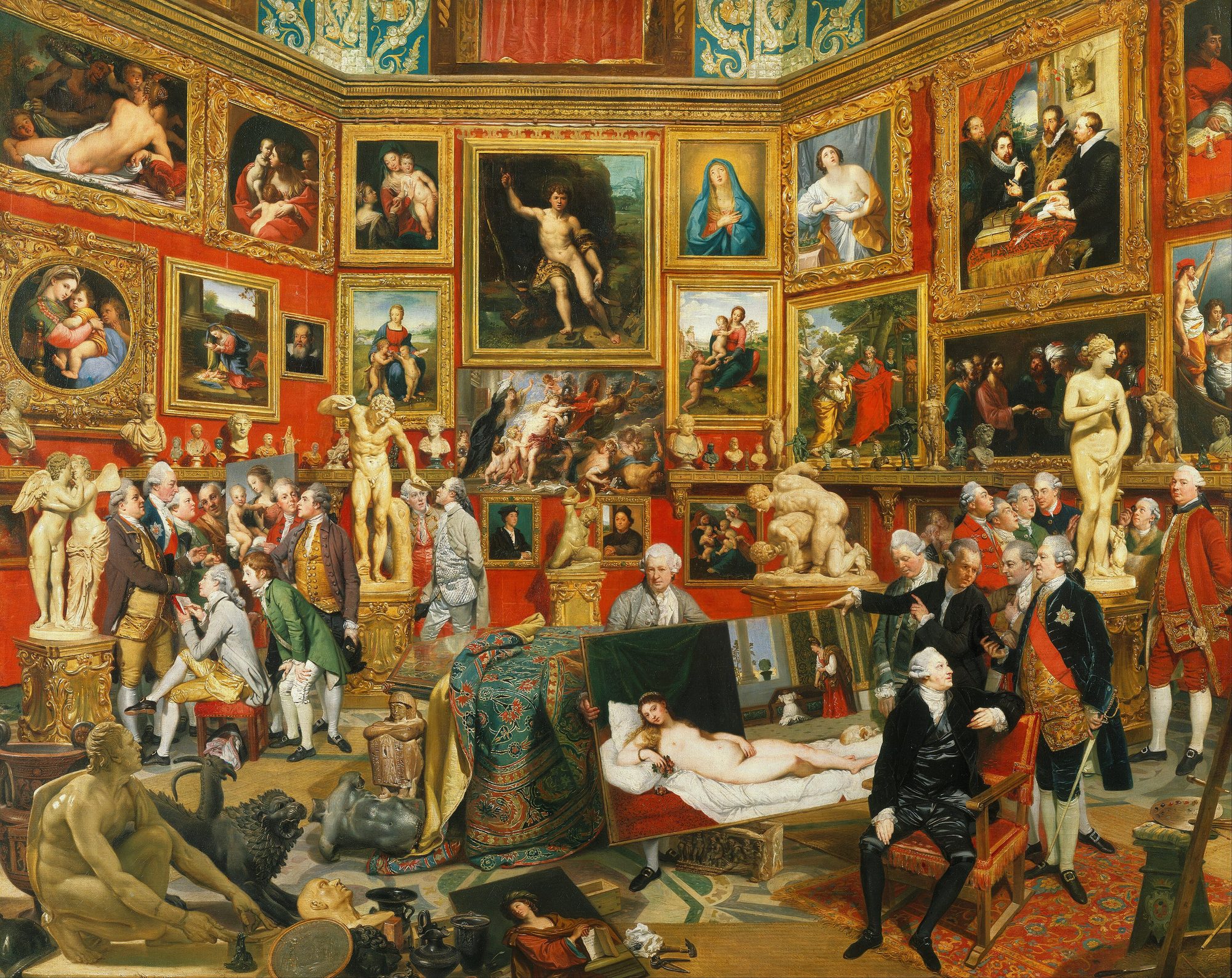
Florence, the Tribuna of the Uffizi
Epistemic status The facts are solid. The theories about why taste changed are mine, held loosely, and offered in roughly ascending order of how much I believe them.
I.
Here is a fact that should bother you more than it does. For roughly two hundred years, from the late 1600s to the middle of the 1800s, educated Europeans agreed on what the most beautiful sculpture in the world was. It wasn’t Michelangelo’s David, which they thought was fine. It was a marble Venus about five feet tall, a Roman copy of a lost Greek original, standing in an octagonal room in Florence.
People crossed the Alps for her, and wrote home about her in the tone usually reserved for lovers. When Napoleon conquered Italy he made sure she came to Paris, and when he fell, getting her back was a matter of national honour. Byron, who was not easily impressed by anything except Byron, stood in front of her and wrote:
We gaze and turn away, and know not where,
Dazzled and drunk with beauty, till the heart
Reels with its fulness. Byron, Childe Harold’s Pilgrimage, Canto IV (1818)
Today, if you go to the Uffizi, the crowd is three deep in front of Botticelli’s Birth of Venus, and the Venus de’ Medici has a doorway, a guard and a lot of personal space.
So either a couple of centuries of the most educated people in Europe were wrong about something they cared about enormously, or we’re wrong, or “wrong” isn’t the right word. I want to go through the possibilities, because I think each one is a little bit true and none of them is the whole answer.
II. What she is, and how she got there
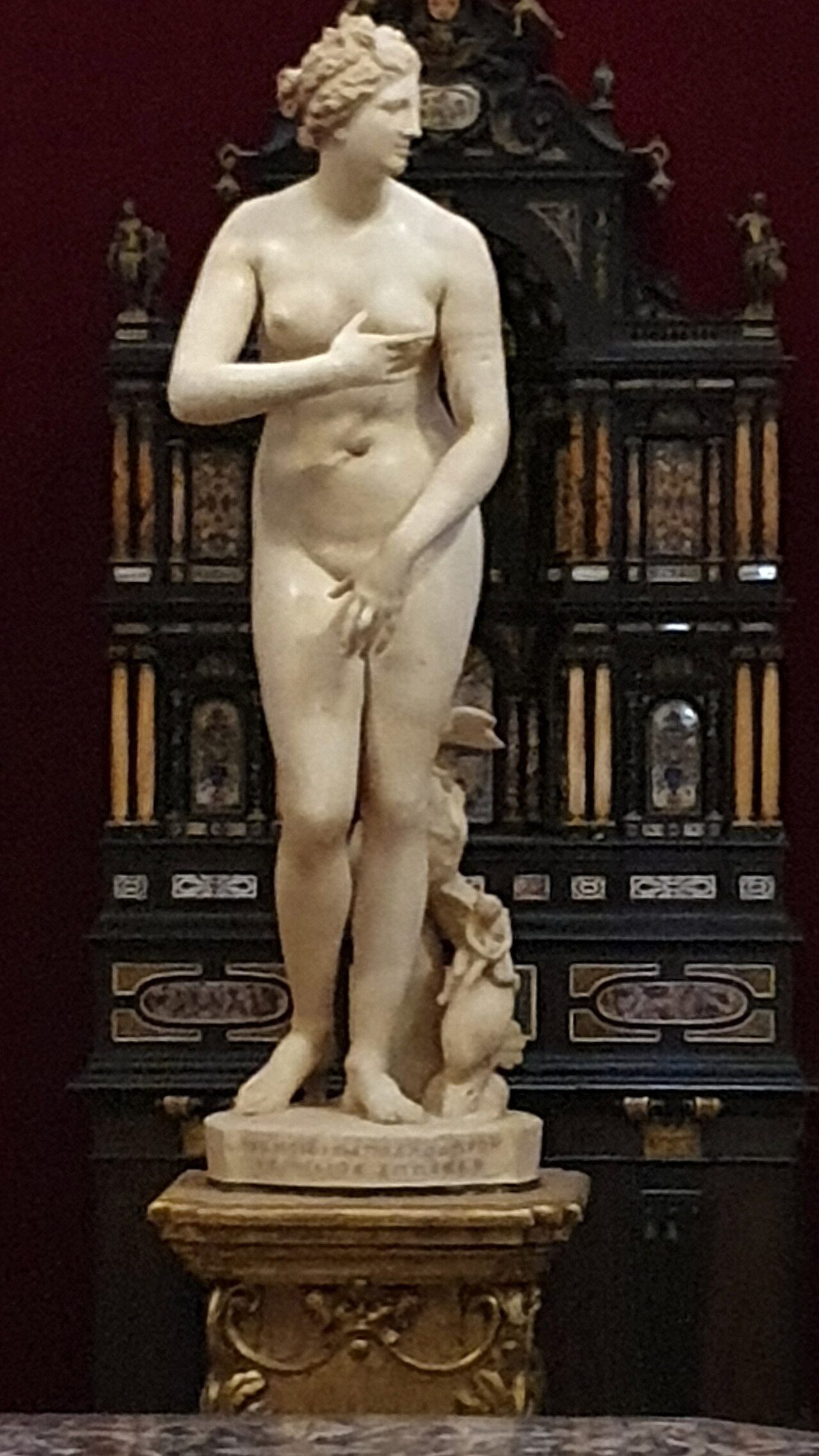
First, the object. She’s a marble Venus caught, apparently, by surprise while bathing, one hand in front of her breasts and the other lower down. It’s a pose known as the Venus pudica, the modest Venus, which is an odd name for a pose that draws your eye to exactly the parts it pretends to hide. A little dolphin at her feet holds her up. The base carries the name of an Athenian sculptor, Kleomenes, son of Apollodoros, though the inscription may well be a later addition. Both her arms are restorations.Restoration in the 1600s meant something different from now. If an ancient statue arrived without arms, a sculptor carved new ones and attached them, and nobody felt obliged to mention it. A surprising share of the “complete” ancient statues people admired on the Grand Tour were part Roman, part Baroque.
She turned up in Rome at some point before the 1630s, nobody is quite sure where, and spent decades in the Villa Medici there. Then, in 1677, she was packed up and sent to Florence. The story goes that Pope Innocent XI, a severe reformer, agreed to let her leave Rome because she was thought to be encouraging lewd behaviour among the people who came to look at her. Rome’s loss was a moral gain. Florence, apparently, could look after its own morals.
By 1688 she was in the Tribuna, the octagonal treasure room Bernardo Buontalenti built for the Medici grand duke Francesco I in the 1580s, with a dome lined in mother-of-pearl shells. And for the next century and a half, she was the centre of the Grand Tour.
III. Exhibit A: a painting of people looking at her
The best evidence of what she meant is the painting at the top of this page. In 1772 Queen Charlotte sent the painter Johann Zoffany to Florence to paint the Tribuna and its treasures. What she expected, presumably, was a careful record of the room. What Zoffany actually spent five years painting was the room full of Englishmen: diplomats, collectors and young lords on the Tour, all identifiable portraits, crowding around the art and pointing at it.
Look at the right-hand side. A cluster of gentlemen is standing behind the Venus, one of them apparently squinting at her bottom through an eyeglass. The painting is a document of art, and also, unmistakably, a document of a social scene. Horace Walpole sniffed that it was full of “travelling boys.” The Queen, according to the usual story, didn’t want it hanging in her rooms.
That gives us our first theory.
IV. Theory one: she was always overrated, and it was all social proof
The cynical view goes like this. Nobody ever really looked at the statue. Everyone knew in advance that this was the most beautiful statue in the world, because their tutor told them so and every guidebook said so. So they stood in front of it, felt the appropriate feelings, and wrote them down. Zoffany’s painting is a picture of a status ritual, rich young men performing taste for one another, and the statue is almost incidental.
There’s real evidence for this. The most famous dissent came from the Scottish novelist Tobias Smollett, who toured Italy in the 1760s and whose temper was not improved by it. He was willing to admit that her limbs were well proportioned, and he praised what he delicately called the “back parts.” But:
I cannot help thinking that there is no beauty in the features of Venus; and that the attitude is aukward and out of character. Tobias Smollett, Travels through France and Italy (1766), Letter XXVIII
Smollett was mocked for this. Laurence Sterne caricatured him in A Sentimental Journey as “Smelfungus,” the traveller who sees nothing but faults. The lesson the culture drew wasn’t “maybe Smollett has a point.” It was “Smollett is a philistine.” That’s what social proof looks like from the inside: dissent gets read as bad taste, not as data.
But I don’t think this theory is enough. It explains why the consensus held. It doesn’t explain how she won in the first place, or why someone as contrarian as Byron fell for it so hard.
V. Theory two: you had to cross a continent to see her
Here’s a theory I like better. Before photography, you could not see this statue unless you went to Florence. There were engravings, plaster casts and small bronze copies for the mantelpiece, and all of them were bad in the specific way that copies of sculpture are bad. The thing itself was a destination. It took weeks of travel, a fortune in money, and a crossing of the Alps by mule.
Think about what that does to an experience. If you have spent three months on muddy roads with the express purpose of standing in this room, you are not going to stand there and think “she’s nice, I guess.” You have paid too much. And you’re seeing her for the first time, really for the first time, because you have never seen a photograph of her from every angle. The statue was rare in a way nothing is rare now.
The Birth of Venus is the most reproduced image in Italy. You have seen it on tote bags. When you finally get to the Uffizi, you are not discovering it, you’re confirming it. And in a strange way, the Venus de’ Medici, which you have probably never seen a picture of, is now the more surprising thing in the building. This is roughly how the cheap availability of a thing changes its value even when the thing itself hasn’t changed at all.
VI. Theory three: the taste changed for good reasons
The third theory is that taste really did move on, and not arbitrarily. In the early 1800s, the Elgin Marbles arrived in London: actual Greek sculpture from the Parthenon, carved in the fifth century BC, not Roman copies of Greek originals. People who looked at them realised that much of what they had been calling “Greek” art was in fact a later, prettier, more polished Roman taste. The marbles were rougher, stranger and more alive. Against them, the Venus started to look a bit too smooth, a bit too finished, a bit Baroque around the arms.
Then the Romantics, and then the nineteenth century, discovered the “primitives,” the painters before Raphael, and Botticelli went in a few decades from forgotten to beloved. Taste moved from the perfect to the expressive, from the finished to the raw. In that world, a statue whose whole appeal was harmonious perfection just had less to say.
On this view nobody was wrong. They were judging by one standard and we judge by another, and both are defensible.
VII. What actually happened to her
Meanwhile, the statue had adventures. When the French armies came into Italy, Florence sent her to Palermo for safety in 1800, and it didn’t help. Napoleon ordered her to Paris in 1802, and in 1803 she was installed in the Louvre, which was then the Musée Napoléon, as one of the great trophies of the age. Florence commissioned Antonio Canova to carve a replacement, the Venus Italica, which you can still see in the Palazzo Pitti.
After Waterloo, she came home. She arrived back in Florence on 27 December 1815. Byron saw her there a couple of years later, still at the very height of her fame. Then, over the next century, the crowds quietly moved on to the next room.
VIII. So, go and look
My actual conclusion is this: the Venus de’ Medici is the best possible test of your own taste, precisely because nobody is telling you what to feel about her anymore. When the Grand Tourists stood in the Tribuna, they had a whole culture’s verdict sitting on their shoulders. You don’t. You have a doorway, a guard and maybe a minute before the tour group behind you gets impatient.
So stand there. Ignore the queue for the Botticelli. Look at her for a full minute, the way someone who had spent three months getting here would look. Is she the most beautiful statue in the world? Is Smollett right? Is it all about the “back parts”?
I’m not going to tell you what to conclude. That would spoil the experiment.
Go see it
- In a museum
The Venus de' Medici in the Tribuna
Uffizi Gallery, Florence. Since the 2012 restoration you look in from the doorways instead of walking through.
Ignore the queue for the Birth of Venus for ten minutes. Stand in the doorway and try to see what Byron saw.
- In a museum
Canova's Venus Italica
Palazzo Pitti, Florence, a short walk across the Ponte Vecchio
The replacement Florence commissioned while Napoleon had the original in Paris. Compare the two in one afternoon.
- Online
Smollett's Travels through France and Italy (1766)
Project Gutenberg. Letter XXVIII is the grumpy Florence one.
Read further
- Francis Haskell and Nicholas Penny, Taste and the Antique (Yale, 1981)
- Venus de' Medici (overview)
Images: Johann Zoffany · Public domain / Yair Haklai · CC BY-SA 4.0


From around the same time

The Chess Machine With a Man Inside
For eighty-four years a mechanical Turk in a turban beat the best players in Europe and America, and supposedly Napoleon too. Clever people spent all that time arguing about how the machine worked. The right answer was the boring one, and it's worth asking why it was so hard to say out loud.
The Mirror You Looked Into With Your Back to the View
Eighteenth-century tourists walked to the best viewpoint in the Lake District, turned round, and looked at it in a small dark mirror. Meet the Claude glass, the phone screen of the 1770s.
The Ambassador Who Kept Climbing the Volcano
Britain's envoy to Naples was meant to be doing diplomacy. Instead Sir William Hamilton climbed Vesuvius dozens of times, wrote it all up for the Royal Society, and hired a painter to record what he saw. The result is one of the most beautiful science books ever printed.