Natural Philosophy · Vienna · 1770–1854
The Chess Machine With a Man Inside
For eighty-four years a mechanical Turk in a turban beat the best players in Europe and America, and supposedly Napoleon too. Clever people spent all that time arguing about how the machine worked. The right answer was the boring one, and it's worth asking why it was so hard to say out loud.
Epistemic status The broad story is very well documented. A few of the most famous episodes, Napoleon and Franklin especially, are legends with uncertain support, and I've flagged them as such.
I. The demonstration
It’s 1770, at the imperial court in Vienna, and a civil servant named Wolfgang von Kempelen has promised the Empress Maria Theresa something better than the conjuring acts she’s been watching.
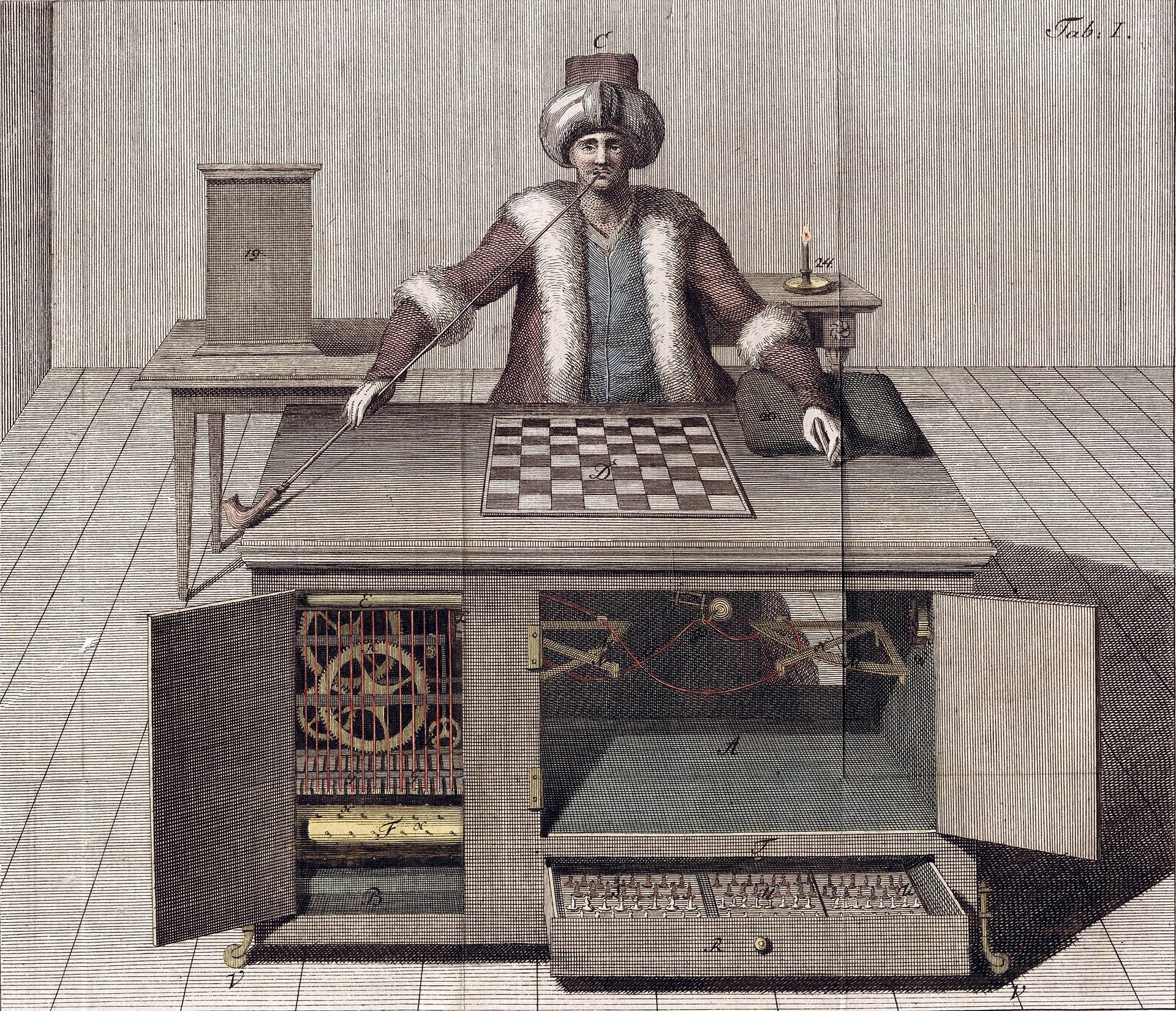
He wheels out a wooden cabinet about the size of a desk. Behind it sits a life-sized carved figure dressed as a Turk, in a turban and a fur-trimmed robe, with a long pipe in one hand. On top of the cabinet is a chessboard. Kempelen opens the cabinet doors one at a time and shines a candle inside, so the audience can see right through it: wheels, cogs, cylinders and levers, a dense thicket of clockwork. He closes the doors and winds the machine up with a key. The Turk turns its head, looks at the board, lifts its arm, and plays chess.
And it plays well. It beats almost everyone. If its opponent tries an illegal move, it shakes its head and puts the piece back. It’s a sensation.
Over the next eighty-odd years the Turk toured Europe and America. It reportedly played Benjamin Franklin in Paris. The story is plausible, and Kempelen did write to invite him, but there’s no contemporary account of the game itself. It definitely beat the young Charles Babbage, twice, in London in 1819, and he went away thinking hard about what machines might do. And according to a famous story, at Schönbrunn in 1809, Napoleon played it, made a series of illegal moves to test it, and on the third, the Turk swept all the pieces off the board.I’d love the Napoleon story to be true, and it might be, but the accounts of it contradict each other on almost every detail. File it under “too good to check, so we checked, and it’s still unclear.”
II. Of course there was a man inside
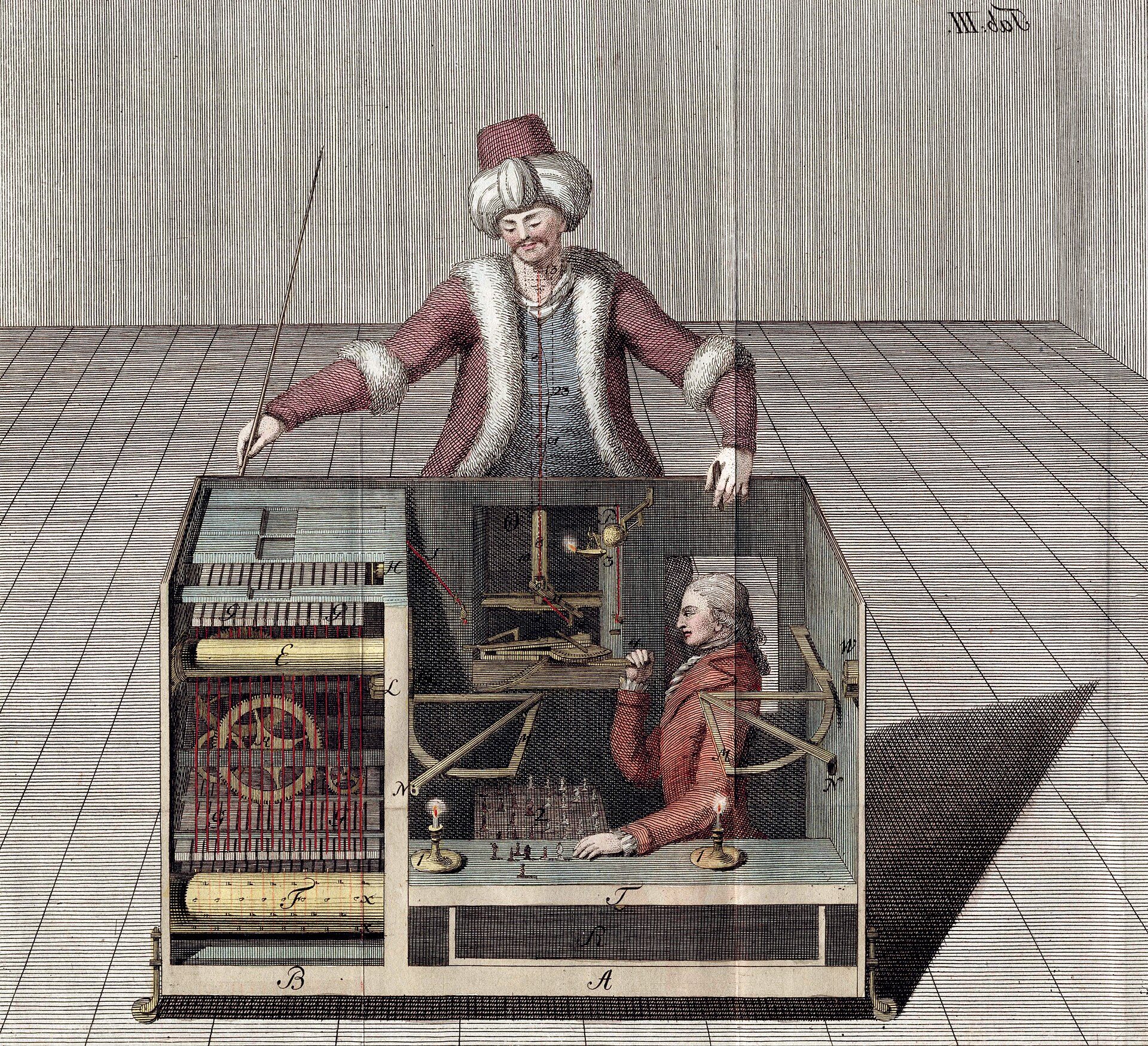
I’ll save you the suspense: there was a man inside. The cabinet was cleverly designed so that a small but very good chess player could slide around on a seat behind the machinery while the doors were opened, one side at a time, giving the audience the impression they had seen right through it. He followed the game on an underside board, where magnets under the pieces moved little indicators so he could see where his opponent had played. He worked the Turk’s arm with a system of levers, and he had a candle for light, with the smoke going out through the Turk’s turban.
None of this was confirmed publicly until 1857, after the machine itself had been destroyed. That year Silas Weir Mitchell, the son of its last owner, wrote a series of articles for The Chess Monthly explaining how it worked.
So the question I find interesting isn’t “how did it work?” It’s this: for more than eighty years, a lot of very clever people saw this machine, thought about it seriously, wrote books about it, and a great many of them did not confidently conclude that there was a man inside. Why not?
III. The case for “it’s really a machine”
I want to steelman the people who were fooled, because they weren’t stupid.
First, the eighteenth century was a golden age of automata, and some of them were genuinely astonishing. In the 1770s the Swiss watchmaker Pierre Jaquet-Droz built a mechanical boy who could write any short sentence you set him with a quill, dipping it in ink and shaking off the excess. Jacques de Vaucanson had a mechanical duck that appeared to eat and digest grain. (It was a fake; the “digested” pellets were stored in advance. But that’s another story.) If you had seen the writing boy, which really was a pure machine, a chess-playing machine was a big step, but not obviously an impossible one. Nobody knew where the limits of clockwork were.
Second, the show was designed with great care to defeat the obvious hypothesis. The cabinet looked too small for a man. You could see through it. The figure was mounted on wheels and could be rolled around the room, so no trapdoor in the floor. Kempelen was careful not to claim too much. He talked the Turk down as a mere trifle, an amusement, and let people work out for themselves how it was done. That made audiences feel clever for suspecting a trick, without ever handing them the specific trick.
Third, a man inside seemed to prove too much. A good chess player small enough to fit in a cabinet, kept in secret, touring for decades? The conspiracy sounded more elaborate than the machine.
IV. The theories, and how they went wrong
So people theorised. The most influential attempt came from a German writer named Joseph Friedrich von Racknitz, who in 1789 published a book with beautiful engravings showing how he thought an operator could be hidden inside. Those engravings illustrate this piece. He was right that a human was in there, and wrong about many of the details of how.
Others went the opposite direction: maybe the operator wasn’t inside at all, but controlling it from a distance with magnets or invisible threads. Maybe Kempelen himself was steering it from wherever he stood. The suspicion only grew after Johann Nepomuk Maelzel, a showman and inventor, bought the machine from Kempelen’s son in 1805, the year after Kempelen died, and took it on the road.
The most famous analysis was Edgar Allan Poe’s. The Turk arrived in America in 1826 and toured for years, and in 1836 Poe published an essay called “Maelzel’s Chess-Player,” concluding that a man was hidden inside. He was right. But some of his reasons were bad. His central argument, for instance, was that a true machine would always win, so the fact that the Turk sometimes lost proved a human was playing. That’s not how it works, as anyone who has played a chess computer on “easy” knows.To be fair to Poe, he also made several good observations about the timing of the doors and the movements of the exhibitor, some of which were borrowed from an earlier exposé. The essay is a lovely example of getting the right answer with a mixed bag of arguments.
V. The lesson I take from it
Here’s what strikes me. For eighty years, the most common error wasn’t believing in a fantastical machine. It was a sort of agnosticism that felt sophisticated. “It’s obviously some kind of trick, but who knows what.” Plenty of observers were sure it was a trick and still spent their energy on clever, elaborate explanations, magnets and threads and hidden accomplices in the audience, instead of saying the simple thing: a small man is sitting in the box. The simple thing felt too crude to be the answer to something so ingenious-looking.
There’s a general rule here, which is that when something seems to do a thing that requires intelligence, the cheapest explanation is usually intelligence, in the most ordinary place you didn’t look. It’s a rule worth keeping in mind in an age when we are constantly being shown machines that seem to think.
VI. The ending, and then the other ending
The Turk ended up in Philadelphia, in a building called the Chinese Museum, which had once housed Charles Willson Peale’s famous collection. On 5 July 1854 a fire that started in a nearby theatre spread to the museum, and the Turk burned. Witnesses later said they heard it calling out “Échec! Échec!”, “Check! Check!”, as the flames reached it. That’s almost certainly not true. It’s a nice line anyway.
The real ending is better. In 2005 Amazon launched a service that lets companies farm out small tasks that computers can’t do well, like labelling images or transcribing receipts, to human workers paid by the task. They called it Amazon Mechanical Turk, in honour of the original. The joke is that from the outside it looks like software, but inside, there are people.
And a lot of what those people did, labelling millions of pictures of cats and stop signs, became the training data for the AI systems that eventually could play chess and identify cats without anyone in the box.
The first chess machine that beat the world champion, Deep Blue, did it in 1997, 227 years after Kempelen wheeled his cabinet into the palace. There was no man inside that one. Garry Kasparov, who lost to it, suspected for a while that there was.
Go see it
- In a museum
Heinz Nixdorf MuseumsForum, Paderborn, Germany. Among the early automata.
Read further
- Tom Standage, The Turk (2002)
- Gerald M. Levitt, The Turk, Chess Automaton (2000)
- Mechanical Turk (overview)
Images: Joseph Racknitz · Public domain / Joseph Racknitz · Public domain


From around the same time
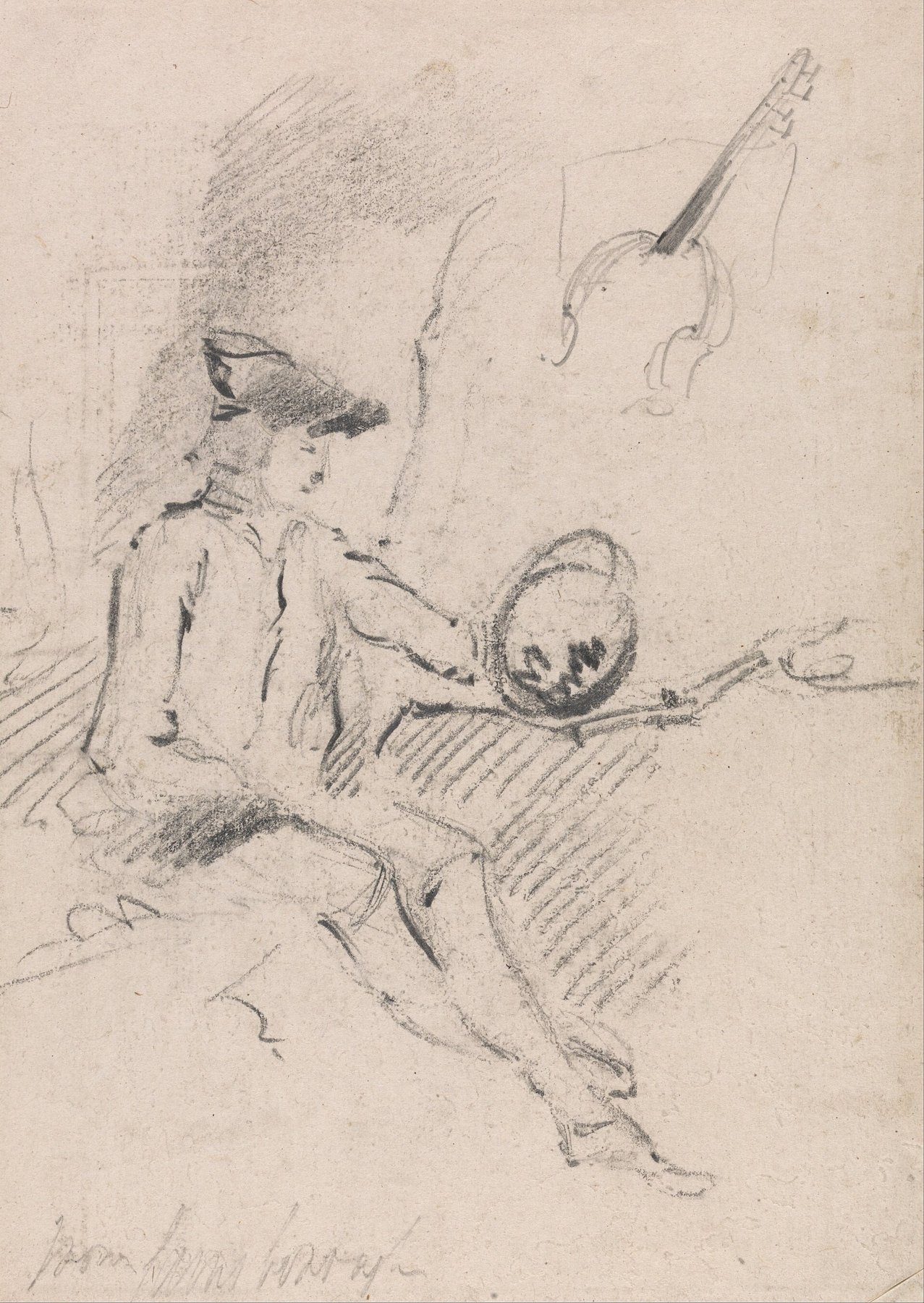
The Mirror You Looked Into With Your Back to the View
Eighteenth-century tourists walked to the best viewpoint in the Lake District, turned round, and looked at it in a small dark mirror. Meet the Claude glass, the phone screen of the 1770s.
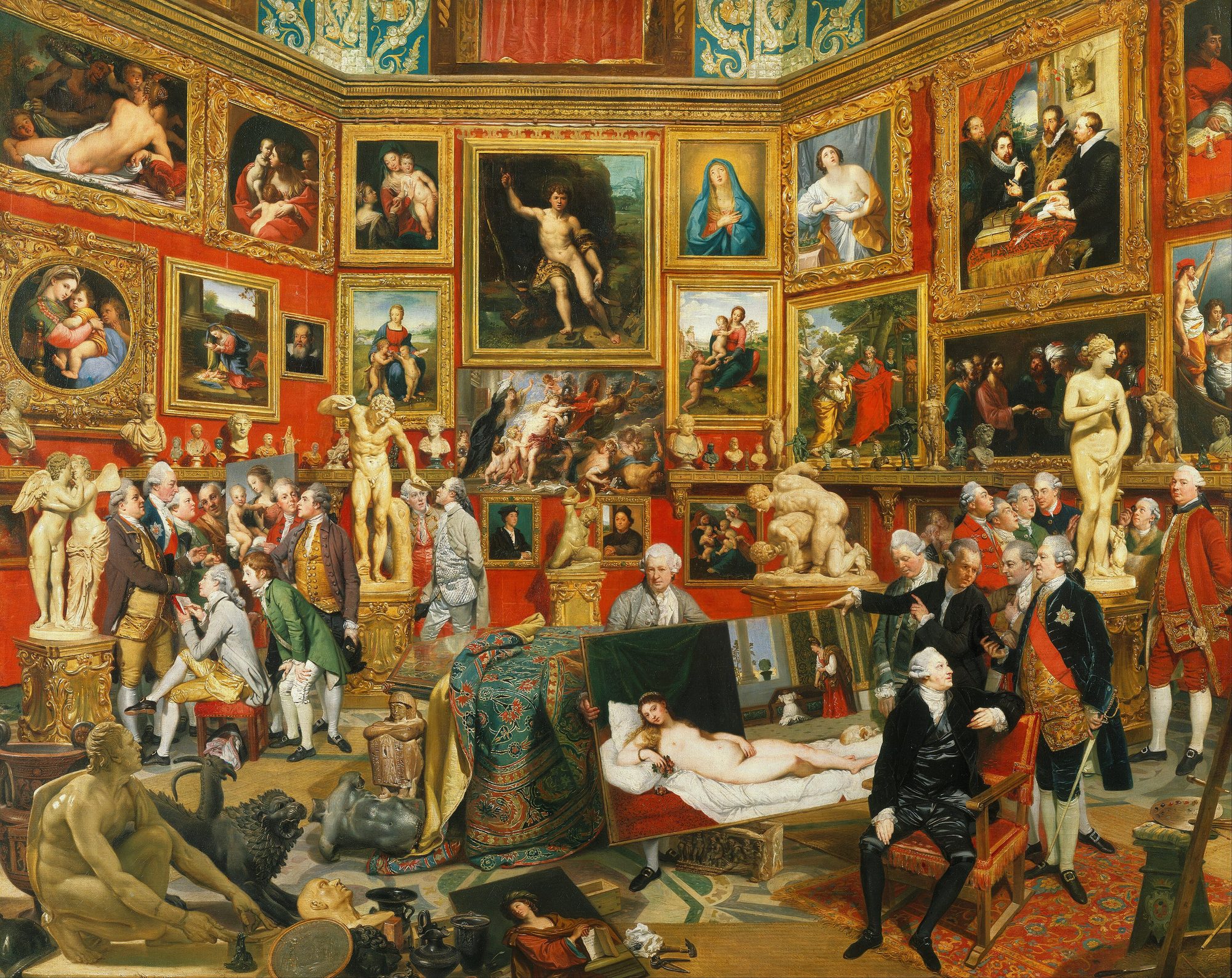
The Most Beautiful Statue in the World (Allegedly)
For two centuries the Venus de' Medici was the thing you crossed Europe to see. Today most people walk past it on the way to the Botticellis. Either our ancestors were wrong, or we are, and both possibilities are more interesting than they sound.
The Ambassador Who Kept Climbing the Volcano
Britain's envoy to Naples was meant to be doing diplomacy. Instead Sir William Hamilton climbed Vesuvius dozens of times, wrote it all up for the Royal Society, and hired a painter to record what he saw. The result is one of the most beautiful science books ever printed.